Saturday, July 13, 2013

Hymnology 101: How to sing a hymn and actually enjoy it

I'll tell you a secret: I love to worship God.1

I believe that God created us to be whole. He did not make us to be simply a mind floating around in an endless sea of abstraction, thinking, calculating, understanding. Neither did He make us to to be a set of feelings, amorphously gushing forth, now in anger, now in sadness, now in pleasure. Nor yet did He make us to be a body, going from task to task, lifting, moving, doing without thought or feeling. He made us to be whole, integrated, experiencing all of these things together in unified purpose, to know what has happened and be sad about it, to accomplish a task and rejoice in its completion, to see a friend in need and act on his behalf. But most of all, He has made us for Himself.

In the Confessions, St. Augustine says:
Thou movest us to delight in praising Thee; for Thou hast formed us for Thyself, and our hearts are restless till they find rest in Thee.
We were made to worship and glorify God! Apart from Him, we can only ever be restless. This does not mean that we can never be happy or fulfilled in any way apart from God, but it does mean that we cannot find the rest and peace our souls long for without Him--how could we, since He is that rest and peace?

He made us to be whole, and He made us for Himself. This is reflected in His commands for how we should worship Him. In Deuteronomy 6:5, He says:
You shall love the Lord your God with all your heart and with all your soul and with all your might.
His intention is that our worship should involve our whole selves, body, mind, and spirit. There are many ways in which I know and serve God. I pray, I teach, I write, I read the Scriptures, I try to do a good job at work, I try to treat others with kindness. In all of these things, I learn about Who He is, what His character is like, and how to relate to Him. However, I usually apprehend Him most directly when I worship Him. I learn about His character, His desires, His plans for me in many ways. I see Him in the beauty of His holiness in worship. These ineffably sublime experiences are, alas, fairly rare, but the deep things of God call out to the deep places in my heart. I long for these moments, and they happen most often in worship.They inspire me to pursue Him in all of the other ways I've mentioned, and pursuing Him leads again to meeting Him, sometimes here and now but ultimately, always and forever.

We live in a postmodern culture. Among other things, this means that we, as a society, have given up on reason as a source of truth and meaning for our lives. Paradoxically, we embrace science and technology, but as sources of convenience, not as sources of meaning. As Sting says,
I never saw no miracle of science
That didn't go from a blessing to a curse
I never saw no military solution
That didn't always end up as something worse...
This attitude has pervaded the church. As a friend of mine recently wrote, "modern evangelicalism is suffering from virulent anti-intellectualism," and, frankly, why wouldn't it? If thought and reason aren't sources of truth and meaning, why would we even attempt to glorify God by using them? Let us focus instead on the emotionally evocative. Evidence of this attitude is sadly abundant in modern worship music.

Don't get me wrong, I go to a contemporary church where we mostly sing contemporary worship songs, and I love it. We are made to be whole. Singing a song with simple lyrics and a simple tune which primarily appeals to my emotions is perfectly consistent with that2. You're hitting two out of the big three. Sing it with all your might! However, we should not, therefore, refrain from worshiping him with our minds. Deep calls to deep. The deep things of God are beyond our ability to comprehend, but that is not because they are without intellectual  or theological content, it's because our intellects aren't powerful enough to understand their theology. Modern worship songs which delve into the mystery of the Trinity or the efficacy of Christ's shed blood for our salvation exist, but they are rare. In worship, our emotions should feed on the Mysteries of God, but our minds should too. This, I think, is where traditional hymns should play an important role in the life of the contemporary church.

The late New Testament scholar Jaroslav Pelikan famously said:
Tradition is the living faith of the dead, traditionalism is the dead faith of the living. And, I suppose I should add, it is traditionalism that gives tradition such a bad name.
Traditionalism is one of the major factors that makes hymns unpopular in contemporary worship. Many people who grew up in traditional churches never experienced life in Christ when they went there. Often, when they  became Christians, it was in some more contemporary setting, and they naturally concluded that traditional worship was simply traditionalistic. Not so, but far otherwise!

In addition, hymns face several challenges in a contemporary worship setting. It is much harder to play a hymn on a guitar than it is to play a contemporary praise song, so one often hears hymns done rather poorly3. This leads some to the incorrect conclusion that hymns aren't very good music. The language of hymns is often difficult as well. They use grammar and word forms that are archaic (thee's, thou's, etc.), and they use words that are not part of most people's vocabulary today (What the heck is an Ebeneezer? Is this a Christmas song?)

So, with all of that in mind, here are some rules of thumb that might help you get something out of singing a hymn:

  1. It's a hymn, not a dirge. You're not at a funeral. It doesn't have to be solemn. It doesn't have to be slow.
  2. Sing a hymn just like you would sing any other song. Put your heart into it. Mean the words you say. Sing the song as a prayer to God.
  3. Understand the vocabulary. If you don't understand a word or a Biblical reference, look it up! (Why do you think God provided you with that smart phone!?)
  4. Understand the grammar. Learn how "thou," "art," and "changest" are used in sentences so that when you see them they are no more strange than "you," "are," and "change."

1 "Worship" is sometimes a dicey word. It can be used to mean the actions and character of our whole lives as we dedicate ourselves to serving God, or it can, in a more limited way, refer to singing songs of praise to Him. I am primarily using the second meaning here, but everything I say here could also be applied to the first. ↩
2 Simplicity should not be confused with stupidity or vapidity. There are certainly contemporary songs which are both. In fairness, however, it should be noted that stupid and vapid worship songs have always been with us. In their day, the stupid songs of the past were just as stupid as the stupid songs of today. However, because of their worthlessness, most of them (thankfully) have not survived to impinge themselves upon our notice today.↩
3 This is not the case at my church. Harry, no criticism is implied or intended.↩

Saturday, July 6, 2013

What is Inductive Bible Study? Part 2

Inductive Bible study is a method for studying the Scriptures in which one comes to the Scriptures to see what they say and then forms an ideas about what they mean. Unlike some other methods of Bible study, in which one comes to the Scriptures with a preconceived idea in mind and looks for proof for that idea, our goal in inductive study is to come to God's Word and allow it to shape our hearts, minds, and actions. This requires us to have a very fitting attitude of humility when we approach the Scriptures and, ultimately, as we approach the Holy God Himself--we are not coming to find justification for what we think we already know, we are coming to be instructed by His Spirit in how He has revealed Himself and to learn what He requires of us.

This method has three parts:
  1. Observation - Looking at the text to determine what is happening
  2. Interpretation - Thinking about the text to determine what it means
  3. Application - Thinking about the text to determine how it applies to my life
In yesterday's post, we made some observations about Mark: 3:1-6:
Again he entered the synagogue, and a man was there with a withered hand. And they watched Jesus, to see whether he would heal him on the Sabbath, so that they might accuse him. And he said to the man with the withered hand, “Come here.”  And he said to them, “Is it lawful on the Sabbath to do good or to do harm, to save life or to kill?” But they were silent. And he looked around at them with anger, grieved at their hardness of heart, and said to the man, “Stretch out your hand.” He stretched it out, and his hand was restored. The Pharisees went out and immediately held counsel with the Herodians against him, how to destroy him.
Today, we will look at how to interpret and apply this passage.

Interpretation

Interpretation is the art of figuring out what a passage means. While observation deals with the Who, What, When, Where, and How questions, interpretation deals with the Why questions. When interpreting, the first rule in inductive Bible study is "stick to what the text says." Look at what is happening in the passage you're trying to understand. Look at what has comes before that passage and at what comes after it. Based on what the text has told you, try to figure out what the people in the passage know how they might feel. Think about what you would do if you were in their situation. Do the people you're reading about do that? Why or why not?

For instance, with our Mark passage, if we look at a little bit broader context, we can see that Jesus had already had a number of encounters with the Pharisees, so he knew they had set themselves against Him. In fact, he had just had an encounter with them about the Sabbath in the preceding passage (Mark 2:23-28), so he knew that they would regard Him healing on the Sabbath as breaking. He knew that the Pharisees were a powerful sect and that they could be vindictive. He could see that they were watching Him to see what He would do. What would you do if you were in Jesus' situation? If it were me, I'd be looking for ways to smooth things over. I'd be looking for some common ground with the Pharisees that I could emphasize when I spoke, or I'd just keep silent, or maybe even not go to synagogue that week at all so that things could die down.

Jesus does none of those things. Instead, he brings the issue the Pharisees have to the forefront. He calls forward the man with the withered hand, and He doesn't just heal him, He calls the Pharisees out and then heals him. The Pharisees prided themselves on their legalistic keeping of the Sabbath to the point where they would put their (erroneous) interpretation of The Rules above doing good and showing kindness. Jesus knows this and He is calling them to repent.

When they refuse, Jesus is angry and "grieved at their hardness of heart." Jesus might be angry at them simply because of their behavior, but nobody grieves when someone they don't care about refuses to change. You grieve when your friend or your child is doing something self-destructive, and, no matter how many times you tell him to he has to stop, that he's ruining himself, he refuses to do it. That is Jesus' attitude here. From this, we can see that, although the Pharisees are enemies of Jesus, Jesus is not the enemy of the Pharisees; that He loves them all and longs for their repentance.

Jesus then goes on and heals the man with the withered hand. At this point, He knows the Pharisees will be angry and heals the man anyway. From this, we can see that He loves the man and does not fear the wrath of the Pharisees, or at least that His love outweighs any fear he might feel.

Finally, the Pharisees are so angry that when they leave they go and plot with the Herodians about how they can kill Jesus. The Herodians, as their name implies were the political party of King Herod. They were the political enemies of the Pharisees, but their hatred of Jesus was so great that they were willing to put aside their differences in to work together on getting rid of Him. What makes people that angry? I can only think of two things: threats to one's power and threats to one's worldview. Jesus is hitting the Pharisees on both of these points. His popularity with the masses undermines the foundation of the Pharisees' power, and His teaching says that their very ideas about how to be right with God are wrong.

Application

This is where the rubber meets the road, where we bring the truth of Scripture to bear on our lives, where we allow God to speak to us, through His Word, about what we say, what we do, and why we do it. We have had the Who, What, When, Where, How and Why questions. Application asks, "So what?"

When applying a passage of Scripture to our lives, we should look at our interpretation and ask questions like this:
  • What are the people in this passage doing that is right?
  • What are they doing that is wrong?
  • What attitudes do they display that are pleasing or displeasing to God?
  • Am I doing the right things?
  • Am I doing the wrong things?
  • What is the attitude of my heart?
  • How do I need to change?
  • What should I continue doing?
  • What does this passage tell me about Who God is?
  • Do I trust and rejoice in that aspect of His character?
For me, application is a mingling of soul-searching and prayer. As I look at the passage through the lens of this kind of question, I ask the Lord to open my heart. To reveal to me what He sees there, to correct what needs correction, and to encourage what needs encouragement.

In applying the Mark passage, I might pray something like this:
Father, I see that you value kindness and doing good over the appearance of righteousness. Is my heart more like your Son's or like the Pharisees'? Do I value my reputation more than I value true righteousness?
You were willing to confront the Pharisees where they were wrong. Please give me that kind of courage. I don't want to condemn or to be self-righteous, but I don't want to let those I know and love suffer the consequences of their sin either. Please give me wisdom about when and how to speak and when I should stay silent. Please fill my speech with Your love and your kindness (which leads to repentance).
Father, please open my eyes to see the needs of those around me. Where I can help, please give me the courage and wisdom to do so. Please help me to regard others as better than myself.
Father, I am not aware of any ways in which you are (currently) challenging my worldview or in which I am hardening my heart against you. Search me, O God, and know my heart. See if there be any hurtful way in me. Please reveal the wickedness in me and grant me a tender heart toward You.
In praying this, I am walking through my interpretation and looking back at the passage and asking the Lord the kind of questions discussed above. When asking Him a question, I try to pause for a while to listen to what He might be saying to me.

Inductive Bible study is a step-by-step process in which each step builds on the last. If I don't look at the text and see what it says, how could I know what it means? If I don't know what it means, how can I apply it in my life? However, what good is it to understand everything about what the Scriptures say if that understanding doesn't affect the way I live my life?

Friday, July 5, 2013

What is Inductive Bible Study?

I've been doing a series of "Inductive Bible Studies" on the book of Matthew, but I haven't stopped to talk about what inductive Bible study is. Inductive Bible study is a method for studying the Bible in which one takes three passes through the text being studied in order to understand God's Word, and to apply it in one's life.

  1. Observation - Looking at the text to determine what is happening
  2. Interpretation - Thinking about the text to determine what it means
  3. Application - Thinking about the text to determine how it applies to my life

In this post, we will take a closer look at the observation phase by examining Mark: 3:1-6:
Again he entered the synagogue, and a man was there with a withered hand. And they watched Jesus, to see whether he would heal him on the Sabbath, so that they might accuse him. And he said to the man with the withered hand, “Come here.”  And he said to them, “Is it lawful on the Sabbath to do good or to do harm, to save life or to kill?” But they were silent. And he looked around at them with anger, grieved at their hardness of heart, and said to the man, “Stretch out your hand.” He stretched it out, and his hand was restored. The Pharisees went out and immediately held counsel with the Herodians against him, how to destroy him.
The point of the observation phase is to determine what is happening to whom and when and how it is happening. This is the plot analysis part of inductive Bible study, and it involves looking at the text and asking yourself  Who, What, When, Where, and How questions.

Who?

The people and groups of people mentioned in this passage are
  • Jesus
  • Man with withered hand
  • Pharisees
  • Herodians
There are several activities involved in answering the "who" question. First, you must untangle the pronouns. You cannot understand the sentence, "He said to him, 'Tend my sheep,'" (John 21:16) until you know who "he" and "him" are. Similarly, you must resolve all symbolic or figurative references--does "he" mean that he literally has a flock of sheep that "he" wants "him" to take care of? If not, what does he mean by "sheep?"

You also need to understand the references to groups of people. Who were the Pharisees? What did they believe? What was their agenda with regard to Jesus? What is a Herodian? Where do they come from? What is their agenda?

What?

Now that we know who is here, we need to ask, "Who did what to whom?" To answer that question, we will look, mostly, at the verbs:
  • Jesus entered the synagogue
  • The Pharisees watched Jesus
  • Jesus said to the man with the withered hand, "Come here."
  • The man with the withered hand came to Jesus
  • Jesus said to the Pharisees, "Is it lawful on the Sabbath to do good or to do harm, to save life or to kill?"
  • The Pharisees were silent
  • Jesus looked at the Pharisees
  • Jesus grieved at the Pharisees' hardness of heart
  • Jesus said to the man with the withered hand, "Stretch out your hand."
  • The man with the withered hand stretched out his hand, and it was healed
  • The Pharisees went out and held counsel with the Herodians to decide how to destroy Jesus
Establishing these facts may raise more questions that need to be answered: What is a synagogue? What is the Sabbath? What does the Old Testament say it was lawful to do on the Sabbath? What did he Pharisees think was lawful to do on the Sabbath?

When?

There are several layers to the "when" questions. This might include the following:
  • What time of day is it? 
  • What day of the week? 
  • What was the season? 
  • Was it a holiday? If so, what was the significance of the holiday? 
  • At what point in Jesus' ministry did this take place? 
  • At what point in the broader historical context did this take place? 
It may not be possible to answer some of these questions, and the answers to others may turn out not to be important, but you can't really tell until you start asking them. In the Mark passage, the day of the week is highly significant, but more on that when we discuss interpretation.

Where?

As with the "when" questions, there are multiple "where" questions you might ask:

  • Is this happening in the city or in the country?
  • Is it happening inside or outside?
  • Is it in a house? by a lake? on a mountain?
  • Are they traveling from one place to another?
  • What region are they in?
  • If the action is taking place somewhere "special" like a synagogue or the Temple, what makes that place special?

How?

Often the "how" questions are so obvious that one answers them in one's head before being aware that they have been asked. "How did Jesus get into the synagogue?" and "How did Jesus talk to the people?" are pretty obvious--He walked and used his vocal apparatus in the same way anyone else would. Sometimes, however, the "how" questions reveal something significant. This usually happens when something out of the ordinary occurs:
  • How did that guy get lowered down through the roof?
  • How did Jesus just "pass through" the crowd that was trying to kill Him?
  • How did Jesus heal that guy's hand?
In these cases, the answers often point to some pretty amazing things like the faith of the paralytic's hands or Christ's divine nature.

Wednesday, July 3, 2013

Matthew 2

Scripture:

Matthew 2

Observation:

vv1-12: The visit of the wise men
vv1, 2: Wise men (Magi) from the east come to King Herod looking for the "King of the Jews" because they saw his star rise. Their intent is to worship Him.
vv3, 5: Herod asks the priests and scribes where the Messiah was to be born.
vv5, 6: Scribes and priests tell him the Messiah was to be born in Bethlehem in fulfillment of Micah 5:2 .
v7: Herod secretly gets the time of the star's appearance from the wise men
v8: Herod sends wise men to find the child and to let him know where the child is. His stated purpose is to worship the child
v9, 10: Wise men go. The star reappears and the wise men rejoice. The star goes before them and comes to rest over the place where Jesus is.
v11: Wise men meet Jesus and Mary. They fall down and worship and offer gifts of gold, frankincense, and myrrh.
v12: Wise men warned in a dream not to return to Herod. They go home a different way.

vv13-15: Joseph, Mary, and Jesus flee to Egypt
v13: In a dream, an angel tells Joseph to take Mary and Jesus to Egypt because Herod is trying to kill Jesus.
v14-15: They go to Egypt and and stay there until Herod dies. Fulfillment of Hosea 11:1

vv16-18: Herod kills all children in Bethlehem
v16: Herod realizes the Wise Men have tricked him. He becomes angry. Rather than killing only the Christ-child, he kills all of the boy younger than two years old, the length of time since the Wise Men had first seen the star
v17-18:  Fulfillment of Jeremiah 31:15

vv19-23: Joseph, Mary, and Jesus return from Egypt and go to Nazareth.
v19-20: In a dream, an angel tells Joseph it is safe to take Mary and Jesus back to Israel
v21: Joseph takes them to Israel
v22-23: Joseph learns that Herod's son, Archelaus is ruling in Judea, so he takes them to Nazareth in the region of Galilee. Fulfillment of prophecy that "He shall be called a nazarite"

Interpretation:

This chapter recounts the visit of the wise men to the infant Jesus. This visit is celebrated on the holiday Epiphany. The wise men are, apparently, court magicians or astrologers from an unspecified kingdom to the east of Palestine. Speculation about their place of origin abounds, but there is no additional information about their place of origin given in the Scriptures. The idea that the wise men were astrologers is supported by the fact that they came to seek the King of the Jews in response to a sign which appeared in the heavens.


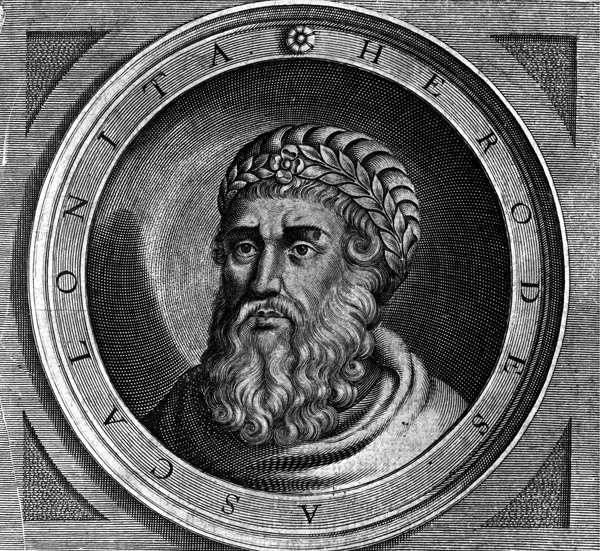
The King Herod to whom the magi came was Herod the Great, the brutal ruler of the Roman province of Judea:
He has been described as "a madman who murdered his own family and a great many rabbis", "the evil genius of the Judean nation", "prepared to commit any crime in order to gratify his unbounded ambition" and "the greatest builder in Jewish history."

When Herod hears the report of the Magi, he is "troubled" because he fears that a rival to his throne has been born. In response he sets in motion a plan to eliminate this potential rival. He knew of the Old Testament prophecies concerning the coming of the Messiah (Christ), so he inquired of the religious leaders where the Scriptures predicted that the Messiah would be born. The religious leaders respond that the Christ would be born in Bethlehem, siting Micah 5:2.

Digging Deeper

As evidence that the Christ would be born in Bethlehem, the priests and scribes site this verse from Micah 5:2:
And you, O Bethlehem, in the land of Judah,
    are by no means least among the rulers of Judah;
for from you shall come a ruler
    who will shepherd my people Israel.
Interestingly, if you actually look up Micah 5:2, it doesn't quite match that:
But you, O Bethlehem Ephrathah,
    who are too little to be among the clans of Judah,
from you shall come forth for me
    one who is to be ruler in Israel,
whose coming forth is from of old,
    from ancient days.
As you can see, the phrasing is somewhat different, but the basic meaning is the same in the first part of the quote. However there is a significant difference in meaning in the final clause--the Shepherd-of-Israel thing doesn't match up to the from-ancient-days thing at all. If you spend much time looking up New Testament quotes of Old Testament Scriptures, you will see that this sort of thing is fairly common. Some critics have looked at differences like these and claimed that they are evidence of errors in the New Testament. While the differences are undeniably there, I would argue that they are not errors, but rather represent a number of cultural differences between the time when the New Testament was written and now.

To dig deeper into this issue, see here.

With the stated intent of worshiping the Child whom the Magi seek, Herod gathers more information about the Child from the Magi and sends them on their way, asking them to return and tell him where the Child is to be found. His real intent, however is to eliminate this rival to his throne.

When the wise men leave, the star which they had seen before reappears and guides them to the place where Jesus was to be found. It is not clear what exactly this star was. There have been many attempts to explain this star as some kind of natural phenomenon which the Magi, as astrologers, interpreted to mean that there was a King of the Jews who had been born. However, this was clearly not a normal star or planet. Stars and planets don't move around like this and they don't stop over a particular house so that you can find it. This seems to have been a unique and miraculous sign of Christ's birth.

When they meet Jesus, the Magi fall on their faces and offer him their gifts of gold, frankincense, and myrrh. Traditionally, gold is said to represent worldly wealth, frankincense is said to represent religious worship, and myrrh is said to represent death. So, symbolically, the Wise Men are offering Jesus all they have physically and spiritually in this world and are trusting in Him for the next.

After this, God warns both the Wise Men and Joseph in dreams that Herod is up to no good. The Magi go home by a different route so that they can avoid Herod, and Joseph takes Jesus and Mary to Egypt. Matthew says that this was done to fulfill Hosea 11:1. If you read this verse in context, it seems to be talking about the historical exodus and Israel's subsequent rebellion:
When Israel was a child, I loved him,
    and out of Egypt I called my son.
The more they were called,
    the more they went away;
they kept sacrificing to the Baals
    and burning offerings to idols.
It was widely believed that the events in the life of the Messiah would parallel in some way the events in the history of Israel. The history of the people of Israel given in the Old Testament was their true history, but it was also seen as a foreshadowing of the life of the coming Messiah. Thus, this Scripture was taken to have a second, metaphorical meaning which applied to the Messiah (at least the called out of Egypt part was, not the rebelling against God part).

This parallel with the Exodus is furthered by Herod's actions when he realizes the Magi aren't coming back, he loses it. Not realizing that they have already fled, Herod has every boy born since the Magi first saw the star killed.This is strikingly parallel to Pharaoh's actions in Exodus 1, when he kills all of Israelite's the male children. Just as Moses was saved from Pharaoh's purge by the actions of his parents (Exodus 2:1-10), Jesus is saved by his parents' actions.

Some time later, Joseph receives another dream in which he is told by an angel that it is safe to go back to Israel. This is the fourth time in Matthew that we have seen God communicate via a dream. Three of those dreams have been given to Joseph, and he has always obeyed the voice of the Lord when it has come to him.

When Joseph is told that it is safe to return from Egypt, he learns that Archelaus, Herod's son is ruling in Judeah. He is afraid, so he takes Mary and Jesus to Nazareth.This seems to be in contrast with Joseph's previous bold obedience, but the Lord's hand was present, even in this. Matthew tells us that even when acting on his fears, Joseph was bringing about the fulfillment of the prophecy, "He will be called a Nazarene."

The Nazarene prophecy is a difficult to understand because this prophecy can't be found in directly the Old Testament. There is an excellent treatment of this issue in this blog post. In short, there are a couple of theories about this verse. One is that the word "Nazarene" is a reference to the nazarite vows talked about in the Old testament. The other is that "nazar" the Greek root word of Nazarene means "branch," and that this is thus a reference to Isaiah 11:1:
There shall come forth a shoot from the stump of Jesse,
    and a branch from his roots shall bear fruit.
This verse speaks of the Messiah as a king restoring the line of Jesse's son, King David.

Application:

In their responses to the news of Jesus coming, we see three different heart attitudes modeled: Herod was hostile, the religious leaders were politely indifferent, and the Magi were worshipful. On the surface, these reactions seem fairly straightforward. Herod was a powerful man who felt that his power was threatened by this coming Christ, the religious leaders were just answering the question they were asked, and the Magi have just traveled who-knows-how-many miles to fine Him--of course, they're going to worship him. However, if you look at these people's background, their reactions are a little more surprising.

Herod had been raised "in the church," and he wasn't one of those kids who walk out the door of the church building, never to look back, the moment they turn 18. In the couple of centuries leading up to Jesus' coming, Jewish thought and religion was obsessed with the coming of the Messiah, so when the Magi came to him, he knew they were talking about the Messiah who was to restore the kingdom of Israel. He was actively involved in his church's building program--in fact, he was a big contributor. He had restored and greatly expanded the Temple of God in Jerusalem. One might expect someone like this to be excited about His coming. Yet Herod reacted with open hostility to the coming of the Savior. He could only see that if Jesus were to be King, Herod could not be.

The religious leaders are, perhaps, even more puzzling. These are men who have devoted their lives to studying the Scriptures. As the teachers of Israel, they have been the ones most deeply involved in Israel's Messianic obsession. They even have correct doctrine. They said the Christ was to be born in Bethlehem, which is just where Jesus was found. These men have yearned for Messiah's coming for their whole lives. Yet these men made no move to worship with the Magi. Content with their correctness, they missed the Messiah for whom they had been longing!

The Magi, meanwhile, were pagan magicians and astrologers. The Old Testament has several things to say about those who practice magic and divination, and none of them are good (Leviticus 19:31 and Deuteronomy 18:9-12 for a sampling). By rights, these men should want nothing to do with the God of Israel. Yet when they saw the miraculous sign of His coming in the heavens, these Magi rejoiced! They procured expensive gifts and left on a lengthy and dangerous journey so that they could lay them at His feet.

In this chapter, we also see the Lord guiding people in various ways. We see God leading with a miraculous sign when he leads the Magi with the star. We see Him speaking speaking directly through His Word, the Scriptures, when the scholars give the location of Jesus' birth. We see Him speaking through dreams, both to Joseph and to the Magi. Less strikingly, however, we also see God lead Joseph to take Mary and Joseph to Palestine through his natural fear. On the surface, this seems like it is just an ordinary human taking an ordinary precaution for the safety of his family, and it is, but God, in his Sovereignty, is also guiding Joseph to Nazareth for the purpose of fulfilling a prophecy about the Savior.

Notice that when God speaks to Joseph and the Magi, they obey Him and through their obedience, God blesses them. Joseph has so far been blessed to be married to Mary, to be the earthly father of the Son of God, and to keep his family safe. The Wise Men were blessed to find Jesus and worship Him. Those who did not obey the voice of the Lord, Herod and the religious leaders came to very different ends.

I believe God still speaks to us in all these ways. Some of them happen significantly less frequently than others, but He is unchanging (Hebrews 13:8) and He has plans for us (Jeremiah 29:11). He wants us to know His will. To this end, it is important for us to know the Scriptures and to study them. In reading Scripture, we give Him the opportunity to speak to us. It is also important to obey Him when He does speak. According to James 1:22-25:
But be doers of the word, and not hearers only, deceiving yourselves. For if anyone is a hearer of the word and not a doer, he is like a man who looks intently at his natural face in a mirror. For he looks at himself and goes away and at once forgets what he was like. But the one who looks into the perfect law, the law of liberty, and perseveres, being no hearer who forgets but a doer who acts, he will be blessed in his doing.

Reflection:

  • In this passage we saw three reactions to Jesus. How has your heart reacted to Him?
  • How as your reaction to Jesus changed over time?
  • How does God speak to you?
  • In what ways do you usually obey Him? In what ways to you usually disobey?
  • Is there something you feel He is telling you now that you don't want to do? If so, why don't you want to do it?
  • Read and reflect on Jeremiah Jeremiah 29:11 and James 1:22-25

Monday, June 24, 2013

Matthew 1


Introduction:

I am starting a series of inductive Bible study posts. I hope to publish one per day, Monday through Saturday. I hope you get as much out of reading them as I do out of writing them. 

Scripture:


Observation:

vv1-17: Jesus' genealogy

vv18-25: Joseph's betrothal and marriage to Mary
v18: Mary betrothed to Joseph, found to be pregnant
v19: Because of his righteousness (ESV justice), Joseph wants to divorce her quietly
v20: Angel of the Lord visits Joseph in a dream. Tells Joseph that Mary is pregnant by the Holy Spirit and not to be afraid to take her as his wife.
v21: Son to be named Jesus. He will save people from their sins
vv22, 23: Fulfillment of Isaiah 7:14
vv24, 25: Joseph marries Mary in obedience to the Lord, but does not consummate their union until after Jesus is born

Interpretation:


Jesus is descended in direct line from Abraham through King David to Joseph, his adoptive father. There were 14 generations from Abraham to David, 14 from David to the exile, and 14 from the exile to Joseph. Notable women are included in Jesus' genealogy: Tamar, Rahab, Ruth, Bathsheba (not by name). With the exception of Ruth, all of these women we notable for their sin: Tamar committed adultery with Judah, Rahab was a prostitute, and Bathsheba committed adultery with David. All of them had endured significant difficulties: Ruth was widowed and destitute until she was redeemed by Boaz.

The focus in Matthew seems to be Jesus' lineage  through His earthly father, probably because Matthew was writing this gospel primarily to the Jews of first century Palestine. Even in Jesus' parents generation, the focus is on Joseph as a just man obeying God rather than on His mother who is his only blood relative; Mary's encounter with Gabriel is absent, but Joseph's encounter with the angel is present. In keeping with the other women named in Jesus' genealogy, Mary is undergoing a significant difficulty--her pregnancy out of wedlock. 

It is notable that, even before his dream, Joseph wants to treat Mary with kindness because of his righteousness, not to punish her to the extent allowable under the Law. In his dream, Joseph is told by an angel that Mary has not sinned, but instead she is with child by the Holy Spirit. Further, that this child will be the promised Messiah who would be born to a virgin.  He would be God with us (Immanuel) and would save His people from their sins (Jesus). Incredibly, Joseph believes all of this and  obeys the Lord. He takes Mary as his wife, in spite of what other people will inevitably think (Mark 6:3). 

Application:

The Lord is less concerned with our past than He is with our future. He knows all of the sin and trouble in our lives, and in spite of that, he wants to include us in His great plan. This is not to say that He doesn't care about sin--Rahab, presumably, did not go on being a prostitute. Bathsheba did not continue to commit adultery. His desire is for us to repent (turn away from) our sins and to move on with Him. 

To be righteous does not simply mean to follow a set of rules. Just as God's kindness leads us to repentance (Romans 2:4), our repentance should lead us to be kind to sinners. 

Jesus Christ is the promised Messiah. He is the living God become man, literally Immanuel. He came to live a perfect life and to save His people from sin through his death on the cross and his resurrection from the dead! 

When the Word of the Lord comes to us, we should all believe and obey as Joseph did, regardless of what anyone else may say or do.

Saturday, June 1, 2013

Knowing God's Will

As a youth minister, sometimes young people sometimes ask me how they can know what God's will is for their lives. Usually, the tone of the question is quite agonized, which is not very surprising--people don't usually ask this question when their lives are quiet and comfortable, and they know just what they ought to be doing. They ask this question when they're having trouble coping with their parents, or when they have just broken up with their girlfriends, or when they are trying to figure out what they should do with their lives, or when they know what they should do but are struggling with being able to do it.

As difficult as the question is for the one asking it, however, it is one of my favorite things to be asked.  When a kid comes to me with this question, he* is usually struggling with some issue, but he is responding to the issue in the right way: by seeking the Lord and trying to do His will. To me, this says good things about his priorities, character, and relationship with God.

I usually try to encourage kids to do the following:
  1. Keep praying about it. When you want to do God's will, you are in agreement with Him. He will help you to do it. Sometimes, however He likes to make is wait before he tells us because the waiting forces us to rely on him. 
  2. Do what you know while you wait for Him to tell you the rest. The Scriptures tell us 90% of what God wants you to do: to treat other people with kindness, to be honest, to tell other people about Him, etc. You should not neglect the 90% while you wait on Him for the other 10%. 
  3. Dig into the Scriptures. They tell you what the 90% is and they make you able to know you are hearing Him when He gives you the other 10%. It is in the Scriptures that He tells us what He is like. By spending time reading the Bible what kinds of things He approves of and what kinds of things he doesn't.
  4. Talk and pray with an adult whom you respect. Pick someone whom you know and whose walk with the Lord you respect. If your parents are walking with the Lord, they are ideal. If not, a pastor, youth worker or some other adult  at your church with whom you have a relationship would be a good choice
Come to think of it, this isn't such bad advice for me...
* Or her. I find constructs like "he/she," "his or her," etc. to be tiresome, and my wife would hunt me down and kill me if I were to publish something using the plural third-person pronoun, "they," with a singular verb. I will, therefore, use the standard English generic third-person pronoun, "he," in spite of the pronoun's unpopularity and of the fact that it is identical to the masculine, singular third-person pronoun. I'm sorry if I offend (but perhaps not as sorry as you think I should be if you are one who is offended).

Relaunch

I started this blog several years ago, and I never really went anywhere with it. I've been thinking and praying about it a fair bit recently, and I've decided to give it another go. I'm not sure exactly where this will go.  I have several interests that I think will come into play here (in no particular order):

  • Theology
  • Philosophy
  • Youth Ministry
  • Software Development
  • Family Life
I may end up splitting this up into multiple blogs so that, assuming anyone ever reads this, those of you who are interested in the crazy things my sister and I did as kids won't be bothered by technical discussions of programming languages and those of you interested in how to write effective unit tests won't be bothered by discussions of the nature of the Trinity. For now, however the topics discussed in this blog will be as jumbled together here as they are in my own muddled head. If you read this, I hope you enjoy.